







Our Collection
A Collection of National Significance
The Golden Dragon Museum (GDM) is one of Bendigo’s most important cultural and tourism assets. Originally established to house and showcase the Bendigo Chinese Association’s Collection, the Museum is primarily a social history museum with a commitment to conserve and protect Bendigo’s Chinese heritage, and to celebrate Chinese culture in the Chinese-Australian diaspora.
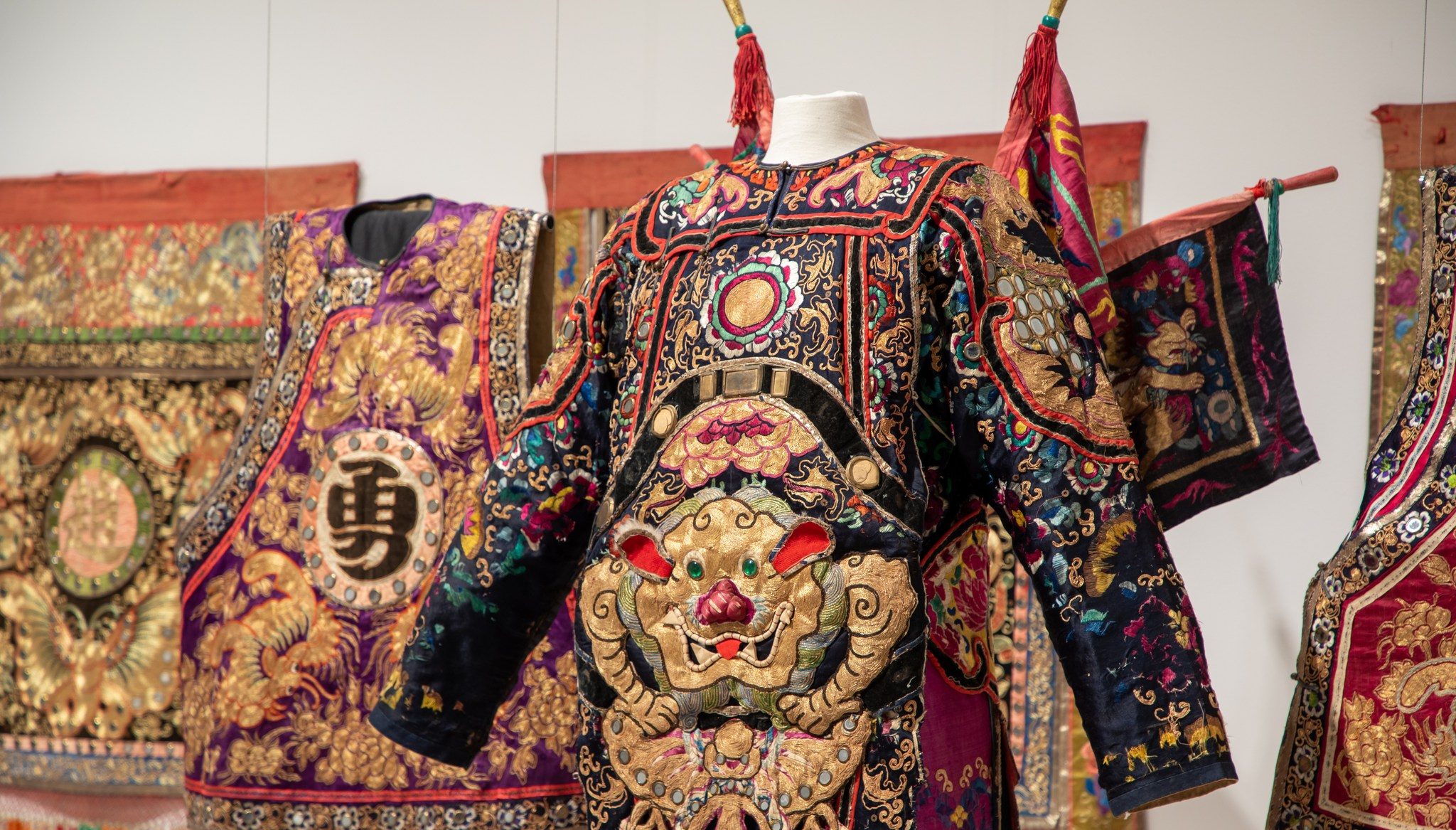
The Golden Dragon Museum has a Collection of some 30,000 objects ranging from Imperial Processional Dragons to textiles, metalware, stoneware, woodwork, photographs, and documents. The Collection holds a particular focus on the Bendigo region and the surrounding goldfields area but also holds items relating to Chinese-Australian history nationally. Its quality, depth and range make it the most important collection of Chinese cultural and heritage material in Australia and one of international significance. Critical to its importance is the fact that parts of the Collection are still used today for cultural and ritual purposes by the local Bendigo Chinese community, particularly during the Bendigo Easter Festival, just as they have been for over 100 years.
Themes in the collection include:
- Chinese-Australian diasporic history
- Domestic life
- Education and Art
- Local families and identities
- Religious life
- Working life
- Dragon Processional history
- Cultural practice and ceremony
- Associations and groups.
Alongside the GDM collection, the Museum holds custodianship of the Bendigo Chinese Association Collection and significant items owned by The City of Greater Bendigo. GDM holds the responsibility of the care and ongoing management of these collections in their permanent home in the museum.
Statement of Significance
In early 2021 Dr Sophie Couchman, an expert in Chinese Australian history and culture, was commissioned to undertake a Significance Assessment of the Golden Dragon Museum’s Collection. For the first time, the 30,000 or so objects in the Collection were considered and assessed, looking both at key individual pieces and the Collection as a whole.
Significance Assessments help museums to better understand their collections, their areas of strength and where they can best be further developed. A Significance Assessment is also invaluable for informing future exhibition programs as well as planning public and education programs. Significance Assessments are current often for years, even decades as they form an essential part of how a museum cares for, researches, develops and uses their most valuable asset; their collection.
Dr Couchman has described a Significance Assessment as ‘A reasoned, readable summary of the values, meaning and importance of a collection. It is more than a description of what the collection looks like. A Significance Assessment summarises how and why the collection is important. It is supported by research and evidence assembled through the assessment process.’ The Statement of Significance is the key findings of the Assessment and draws attention to the unique qualities of the Golden Dragon Museum’s Collection.
Following is Dr Couchman’s Statement of Significance of the Collection at the Golden Dragon Museum:
Although trade links between China and Australia pre-date British colonisation, Chinese only began arriving and settling in Australia in large numbers from the 1850s goldrushes. They become the largest non-British immigrant group in Australia at this time. Popularised pseudo-scientific ideas about race and racial hierarchies shaped how these Chinese arrivals were treated. This in turn drove Government legislative responses to Chinese immigration. This legislation was adapted to control all non-white immigration as part of the White Australia Policy. While the White Australia Policy has been dismantled, the repercussions of this period of our history continue to reverberate through Australian society and to shape Australia’s relations with Asia. With a sizable ethnically Chinese population and the rise of the People’s Republic of China as a global power, understanding Australia’s Chinese history continues to be highly relevant today.
Despite the significant role of Chinese during the goldrushes and as a part of Australia’s immigration history, until the 1970s and 1980s their role and contributions were largely overlooked in the histories and collections of public institutions. The Golden Dragon Museum was established in part to rectify this. Its construction in Bendigo’s declining Chinese quarter highlights its role telling this local history. The Museum holds a rich and large collection of objects, textiles, photographs, documents and oral histories that relate to the family and community lives of Chinese and their descendants in Bendigo, the wider Victorian goldfields and beyond. The Museum also seeks to foster an appreciation of Chinese arts and culture through its collection.
An important function of the Museum has been to house the Bendigo Chinese community’s growing collection of processional regalia used in the Bendigo Easter Fair since the late nineteenth century. Chinese processions were relatively common in the nineteenth century, but Bendigo’s is the only one to have continued to the present day. The procession draws on nineteenth century Cantonese cultural practices but transforms these into a uniquely contemporary Australian event.
The Golden Dragon Museum and its collection through its association with the annual Bendigo Easter Fair, the Bendigo Chinese Joss House Temple and the historic White Hills and Bendigo cemeteries has a high social and spiritual significance. The Chinese Easter Fair procession is a focal point for Chinese Australian communities nationally and is deeply symbolic of Chinese Australian achievements and endurance. Paying respect to ancestors at the temple and cemeteries personalises this experience.
This spiritual significance is felt beyond Bendigo Chinese families to others in the Bendigo and the wider Victorian goldfields region. Chinese Australians across Australia and international Chinese visitors also feel the power of this symbolism. For overseas visitors, particularly from the People’s Republic of China, the processional regalia is also a reminder of Cantonese social and spiritual practices suppressed and largely lost during the Cultural Revolution. International lion dancing and Cantonese opera troupes visit the collection to connect with this historical cultural legacy.
The collection is rich in research potential. Embedded within the provenance of the collection are the social, familial and business connections that describe Bendigo’s Chinese Australian communities. These networks extend outwards across Australia and internationally to southern Chinese villages, metropolitan centres like Hong Kong and Shanghai and across the Chinese diaspora. The fine-grained local community history captured within the Museum’s collection has high state, national and international significance.
The Museum’s collection of material related to the Bendigo Chinese Association and local lodges of the Yee Hing / Chinese Masonic Society has the potential to greatly enrich our understanding of these organisations and communities locally and internationally. In addition, they help to show how Bendigo shaped the nature of these groups over time. Both organisations had strong ties to other similar Chinese organisations across Australia, in southern China and across the Chinese diaspora. Both played an important role in the nature of Chinese-Australian communities. These collections have high historical significance.
Contained within the collection are items of high artistic or aesthetic value. The Qing-dynasty processional regalia is particularly stunning in its artisanship, quality of fabric and condition but later collections also have high aesthetic value. Social history collections are not predicated on aesthetics but contained within the Chinese Australian social history collection are high quality textiles such as Charles Powell Hodges imperial robes and other textiles, photographs and beautifully decorated documents and objects. Many pieces within the John St Alban collection are impressive in size, artistic design, workmanship, and materials. They provide insight into Qing dynasty Han Chinese and Sino-Mongolian fine and decorative arts.
The provenance of the processional regalia and Chinese Australian history collections is very strong, often linked to particular individuals and businesses and donated to the Museum by descendants or close family friends. This provenance has been enhanced by the extensive research archive, library and the deep local knowledge of staff members. For families researching their family history these collections have powerful spiritual significance in addition to their historical significance.
There are numerous items in the collection that are rare, unusual or uncommon in public collections, but the Museum’s collection is more significant in its entirety than any one particular object. The Qing dynasty processional regalia and even individual items within it have high historic, aesthetic, research, social and spiritual significance on their own but their significance is greatly enhanced by being part of the set of Qing dynasty regalia. It is even further enhanced by being part of a multigenerational collection of regalia that reflects an unbroken and continuing cultural practice that has evolved since at least the 1870s.
Similarly, there are individual items within the Chinese Australian social history collection that are significant in their own right, but the real strength of the collection is the deep insight it provides into the Bendigo Chinese community as a whole. No other single collection in Australia is able to provide the depth of insight into a Chinese community as large as Bendigo’s, in the detail it does, over such an extended time period. A deep understanding of Bendigo’s Chinese community helps us better understand the histories of Chinese communities around Australia and internationally and, through the connections of Chinese Bendigonians, helps us understand Chinese Australian social and business networking and mobility. This gives the Museum’s collections a national significance.
Dr Sophie Couchman
July 2021